1948-2023 . Retired Statistician, Poet, author, historian and campaigner. Co-founder of International Society for Bayesian Analysis and of the Edinburgh All Comers Writers Club and Participant in the 2019 UCL Eugenics Inquiry.
Search This Blog
Wednesday, 15 June 2016
THE TENTH ANNIVERSARY by James L.S. Carter
THE TENTH ANNIVERSARY
James L.S. Carter
And so, ten years have passed, ten long sad years,
Ten Winters and ten Summers and ten Springs,
Ten Seasons of the leaf-world's downwardings
And all the gloom of frost and dead flower tears.
Frost in our hearts too, frost like little spears
That brittly cool, break, shatter; battle-ings
In the war-service that Survival brings
To harm the Spirit with the coldest fears.
I daily hear the humour of your voice
In which our childhood vagaries I trace.
I nightly wait the outline of your form
And wish that it still wore the body warm.
So melancholy are these final days
That I can wish we'd not been brother-boys---
Sacred the mem'ry we commemorate!
Sacred the life that is so sadly gone!
And sacred is the annivers'ry-date
On which a melancholy sun did dawn.
That day, I little knew what tragedy
Awaited all its mis'ry to inflict
And devastate the remnant family,
Awaited the bereaved ones to afflict.
And sacred too the bonds which bind us still
Long may they last! Long may they never die!
We live now and should love each other till
The day we reach our immortality.
And even then our sacred hope and love
Should long outlast the grave and graveside grove.
Monday, 13 June 2016
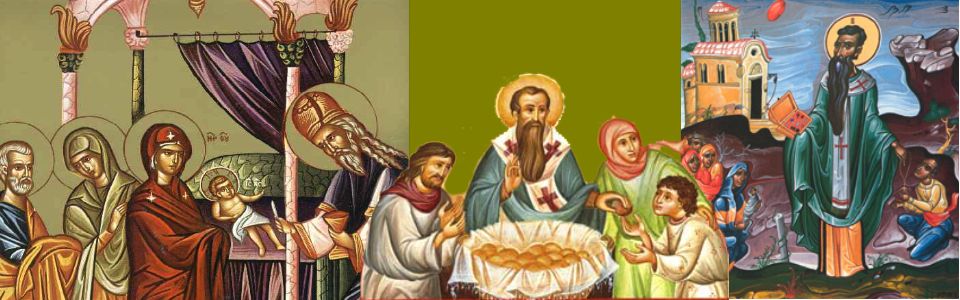
THE SOCIAL DOCTRINES OF ST. BASIL THE GREAT
IN COMMUNION
Basil’s social doctrine is grounded in the conviction that all people are equal and share the same human nature. The poor, the rich and the emperor are all companions in slavery, that is, they are all dependent on God. Moreover, human beings are social creatures and communal life and interaction with one another require a generosity that can alleviate the needs of the destitute. The scriptural command to “Give to anyone who asks” calls us to a sharing and a mutual love that are characteristic of human nature. The Acts of the Apostles teaches us how this is to be put into practice. In the first ecclesial community of Jerusalem, the Christians sold their goods and gave the money to apostles to distribute to those who needed it.
Basil encouraged the faithful Christians of his time to respond to the Gospel injunction to “sell your possessions and give to those in need.” He had long ago responded to this call and committed himself with all his heart to a life of voluntary poverty. In the Acts of the Apostles, the giving away of one’s possessions is presented as a free choice, and in the Gospel it is seen as a condition of perfection. However, Basil became even more radical and saw it as a rule of life for all Christians. Moved by the extreme social needs of the population, and enlightened by the Scriptures, Basil insisted that the produce of the earth was intended for all. While God the Creator had indeed distributed it unevenly, he had done this with the intention that the rich should share with the poor.
ARCHBISHOP OF CAESAREA
BASIL THE GREAT (Orthodox Wiki)
Our father among the saints Basil the Great (ca. 330 - January 1, 379), was bishop of Caesarea, a leading churchman in the 4th century. The Church considers him a saint and one of the Three Holy Hierarchs, together with Saints Gregory the Theologian(Gregory Nazianzus) and John Chrysostom. Basil, Gregory the Theologian, and Basil's brother Saint Gregory of Nyssa are called theCappadocian Fathers. The Roman Catholic Church also considers him a saint and calls him a Doctor of the Church.
Basil's memory is celebrated on January 1; he is also remembered on January 30 with the Three Holy Hierarchs. In Greek tradition, he is supposed to visit children and give presents every January 1. This festival is also marked by the baking of Saint Basil's bread(Gr. Vasilópita), a sweetbread with a coin hidden inside.
He should not be confused with Saint Basil the Blessed, Fool-for-Christ, a Russian saint, after whom St. Basil's Cathedral, on Red Square in Moscow, is named.
He also should not be confused with Saint Basil of Ostrog, a Serbian saint, who built the Ostrog Monastery which is caved in and stands on a very high hill between Danilovgrad and Niksic.
Icon of St. Basil the Great from the
St. Sophia Cathedral of Kiev | |
| Bishop, Confessor and Doctor of the Church; Great Hierarch | |
|---|---|
| Born | 329 or 330 Caesarea, Cappadocia, |
| Died | January 1 or 2, 379 Caesarea, Cappadocia |
| Venerated in | Eastern Orthodox Church Oriental Orthodoxy Roman Catholic Church Anglican Communion Lutheranism |
| Canonized | Pre-Congregation |
| Feast |
|
| Attributes | vested as bishop, wearingomophorion, holding a Gospel Book or scroll. St. Basil is depicted in icons as thin and ascetic with a long, tapering black beard. |
| Patronage | Russia, Cappadocia, Hospitaladministrators, Reformers,Monks, Education, Exorcism,Liturgists |
Basil of Caesarea, also called Saint Basil the Great (Greek: Ἅγιος Βασίλειος ὁ Μέγας, Ágios Basíleios o Még
GOLD MEDAL FOR EVE (Poem)
GOLD MEDAL FOR EVE
by Thomas Hoskyns Leonard
Dedicated to Eve (Ward 206, Royal Edinburgh Infirmary)
Lady Eve of the Lamp,
Saviour in uniform full vamp,
Waits in Ward 206 for sick to encamp
Lest they to Heaven decamp.
My arms and head tremble and shake
During a literary lunch with heartache.
In the nighr my leg catches fire on the bake,
So Julie and Scott me to the Royal Infirm take.
Pushed on the Red Line to Eternity
In a swerving wheelchair by my fraternity,
I crash onto the ground for my fragility;
Scott loses gum in eye for his agility.
In Dickensian holding ward, demented ninety-year old
Rules the fort, taunts nurses and doctors for sport.
They've filled me with vein scorching anti-biotic
That doesn't even turn me psychotic.
On upwards in Trolley to Ward 206,
In a place more like Folksvangr than the Styx,
Where angels reign and Lucifer does not linger,
Where God peers at sheep, and points his finger.
My leg boils while nurses toil
To find a vein my infection to foil;
But veins twist and turn, as nurses grind and churn;
Skin splits,flesh rots,and blood flows, while I burn.
But Sister Eve waves her hips, and finds a place,
Which she can with her silver needle a spot engrace;
She slides it in, as neat as a pin,
And I begin to pull out of my fiery spin,
Oh Sister Eve, wondrous Goddess of Love,
You made me feel like a brotherly dove.
You deserve a gold medal for your expertise,
And this I award you for your synchronicitise,
Which Fortuna herself could not egalitise.
BACK FROM OBLIVION
i arrived home from the Royal Infirmary today still feeling traumatized by my experience of some eight days previously. My thanks to Thomas, Scott , Julie, Steven, James, Eystein, and Paul for visiting me in Ward 206. My thanks also for all the messages of support from my Facebook friends, But above all my eternal thanks to by flatmate Scott and his friend Julie, for effectively saving my life at a time when I had long since lost the plot
This has been a good time for enhancing my friendships and family relationships, I will resume my duties as moderator for Mental Health Discussions Edinburgh shortly,
Thursday, 2 June 2016
More about PLUTO
PLUTO'S BEATING HEART EXPLAINED
Pluto is a dwarf planet. A dwarf planet travels around, or orbits, the sun just like other planets. But it is much smaller.
Clyde Tombaugh discovered Pluto in 1930. He was an astronomer from the United States. An astronomer is a scientist who studies stars and other objects in space. Venetia Burney named Pluto that same year. She was an 11-year-old girl from England.
Pluto is not very big. It is only half as wide as the United States. Pluto is smaller than Earth's moon. This dwarf planet takes 248 Earth years to go around the sun. If you lived on Pluto, you would have to wait 248 Earth years to celebrate your first birthday. One day on Pluto is about 6 1/2 days on Earth.
Pluto is about 40 times farther from the sun than Earth is. Pluto is in an area of space called the Kuiper (KY-per) Belt. Thousands of small, icy objects like Pluto but smaller are in the Kuiper Belt.
This dwarf planet has five moons. Its largest moon is named Charon (KAIR-ən). Charon is about half the size of Pluto. Pluto's four other moons are named Kerberos, Styx, Nix and Hydra.
- Pluto is named after the Greek god of the underworld.
This is a later name for the more well known Hades and was proposed by Venetia Burney an eleven year old schoolgirl from Oxford, England. - Pluto was reclassified from a planet to a dwarf planet in 2006.
This is when the IAU formalised the definition of a planet as “A planet is a celestial body that (a) is in orbit around the Sun, (b) has sufficient mass for its self-gravity to overcome rigid body forces so that it assumes a hydrostatic equilibrium (nearly round) shape, and (c) has cleared the neighbourhood around its orbit.” - Pluto was discovered on February 18th, 1930 by the Lowell Observatory.
For the 76 years between Pluto being discovered and the time it was reclassified as a dwarf planet it completed under a third of its orbit around the Sun. - Pluto has five known moons.
The moons are Charon (discovered in 1978,), Hydra and Nix (both discovered in 2005), Kerberos originally P4 (discovered 2011) and Styx originally P5 (discovered 2012) official designations S/2011 (134340) 1 and S/2012 (134340) 1. - Pluto is the largest dwarf planet.
At one point it was thought this could be Eris. Currently the most accurate measurements give Eris an average diameter of 2,326km with a margin of error of 12km, while Pluto’s diameter is 2,372km with a 2km margin of error. - Pluto is one third water.
This is in the form of water ice which is more than 3 times as much water as in all the Earth’s oceans, the remaining two thirds are rock. Pluto’s surface is covered with ices, and has several mountain ranges, light and dark regions, and a scattering of craters. - Pluto is smaller than a number of moons.
These are Ganymede, Titan, Callisto, Io, Europa, Triton, and the Earth’s moon. Pluto has 66% of the diameter of the Earth’s moon and 18% of its mass. While it is now confirmed that Pluto is the largest dwarf planet for around 10 years it was thought that this was Eris. - Pluto has a eccentric and inclined orbit.
This takes it between 4.4 and 7.3 billion km from the Sun meaning Pluto is periodically closer to the Sun than Neptune. - Pluto has been visited by one spacecraft.
The New Horizons spacecraft, which was launched in 2006, flew by Pluto on the 14th of July 2015 and took a series of images and other measurements. New Horizons is now on its way to the Kuiper Belt to explore even more distant objects. - Pluto’s location was predicted by Percival Lowell in 1915.
The prediction came from deviations he initially observed in 1905 in the orbits of Uranus and Neptune. - Pluto sometimes has an atmosphere.
When Pluto elliptical orbit takes it closer to the Sun, its surface ice thaws and forms a thin atmosphere primarily of nitrogen which slowly escapes the planet. It also has a methane haze that overs about 161 kilometres above the surface. The methane is dissociated by sunlight into hydrocarbons that fall to the surface and coat the ice with a dark covering. When Pluto travels away from the Sun the atmosphere then freezes back to its solid state - WIKI.
Wednesday, 1 June 2016
BANGERS AND MASH
BANGERS AND MASH RECIPE
WIKI
Bangers and mash, also known as sausages and mash, is a traditional British Isles dish made of mashed potatoes andsausages, the latter of which may consist of a variety of flavoured sausage made of pork or beef or a Cumberland sausage.[1] It is sometimes served with onion gravy, fried onions, baked beans, or peas. It is mostly eaten in the United Kingdom, Canada, Australia, and New Zealand.[citation needed]
This dish, even when cooked at home, may be thought of as an example of pub grub—relatively quick and easy to make in large quantities.[1] More up-market varieties, with exotic sausages and mashes, are sold in gastropubs, as well as less sophisticated alternatives being available in regular public houses.
Bangers & mash is commonly served in so-called 'Irish pubs' in the United States - although there is little or no evidence that the dish is quintessentially Irish, as distinct from 'British' (in the broadest sense of the word)
Subscribe to:
Posts (Atom)