Search This Blog

Tuesday, 26 July 2016

Intentio Editing, by Dr.Eystein Thanisch


                     I would like to highly recommend Eystein for his literary skills, He has given me wonderful assistance in the past when writing my Bayesian History for Wiley and my self-published novels, He has profound knowledge about the Classics, and Celtic poetry and literature,


                                                    INTENTIO EDITING 


For a while now, I have been working surreptitiously as an editor and proofreader, largely for friends, friends of friends, and academic contacts (thank you very much to those involved for the opportunities). This has proved fruitful and rewarding for all concerned, so I am starting to proactively market myself. To this end, I hereby unveil my new website and quasi-business, 'Intentio Editing': www.intentio-editing.com
The rough-and-ready thumbnail is regrettable, but the website is better!
If you know anyone who might find my services useful, please do pass the link on. And if anyone has any feedback on the website, then that will be gratefully received. I am going to dish it out, so I need to learn to take it...


GETTING YOUR BRAIN WIRED FOR AN AMBULATORY EEG


Introduction

Ambulatory electroencephalography (AEEG) monitoring is a relatively recent technology that allows prolonged electroencephalographic (EEG) recording in the home setting.[1] Its ability to record continuously for up to 72 hours increases the chance of recording an ictal event or interictal epileptiform discharges. AEEG is a less expensive alternative to inpatient monitoring, with costs that are 51-65% lower than a 24-hour inpatient admission for video/EEG monitoring.[2]
Continuous cardiac monitoring was first described by Holter in 1961.[3] The development of portable EEG recording proved more problematic than the Holter monitor because of the need for signal amplification and multichannel recording. A multichannel portable recorder was developed in the early 1970s. This technology was later adapted to EEG recording, and miniature preamplifiers that could be worn on the head were developed.[4, 5]
Early clinical investigations documented the ability of AEEG to record identifiable focal and generalized epileptiform activity.[6, 7] In 1982, Ives introduced a 16-channel AEEG that utilized signal multiplexing.[8] The 16 channels allowed improved spatial resolution and localization but recorded discrete samples rather than continuous EEG.
In 1983, a cassette tape AEEG system was introduced; it used off-head preamplifiers that had continuous 8-channel recording capability, real-time identification, and gain and filter adjustments.[9, 10, 11, 12]
In the past decade, computer technology has enabled portable recording of up to 36 channels with sampling rates of up to 400 Hz. Currently, numerous AEEG systems are available commercially (see the image below).
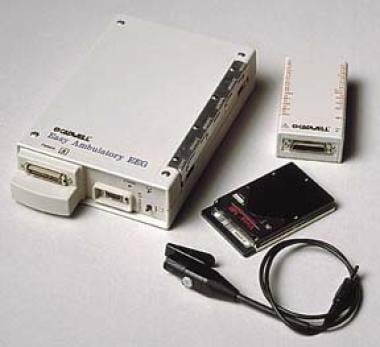
Components of an ambulatory EEG system. Components of an ambulatory EEG system.
                                   What is causing my all-too-frequent apparent absence seizures? Today Thomas took me once again to the Western General for yet another in a series of madcap adventures, To my surprise, a couple of dozen wires were glued to my skull for a 24 EEG. This is my fourth diagnostic test since the gobsmacking advice which I received at the same illustrious institution in March
                                       PREVIOUS STRANGE ADVICE FROM A CONSULTANT NEUROLOGIST
                                                       Afterwards, Thomas took me for a slap up meal in Silverknowes                                                                                
                                      WIth apologies to Donald Trump, and with no intentipn to give offence to the waiter or anybody else

WORK PLACE AIR CONDITIONING--A STATISTICAL SURVEY


                                    Workplace Air Conditioning

A new survey by the Office of National Statistics - www.statistics.gov.uk reveals that a massive 92% of office workers waste up to an hour a day due to overheated offices - costing British employers a combined £19.3 million in lost productivity throughout the summer months.

Neuropsychologist Dr David Lewis, conducted a unique experiment into workers productivity in overheated offices, the heat causes concentration to falter, the number of mistakes we make multiply and our problem solving ability nosedives.
"If we are too hot, our metabolic rate decreases, causing us to slow down mentally and physically. It is remarkable how little time it takes brains to go into meltdown when the temperature is increased," he said. What are your workers’ rights if it gets too hot this summer?
The British Safety Council concludes that when people experience temperatures in excess of 24C the propensity for accidents increases and work productivity diminishes.

It is important for employers to maintain staff productivity by providing solutions to overheating in the office either by commissioning installations of air conditioning systems or at least portable air conditioning when the heat becomes unbearable.  Ecoair has a wide range of air conditioning, some requiring no technical installations at all. View EcoAir’s range of Portable Air Conditioning and Air Conditioning Installation Packages.

Employers must ensure that during working hours, the temperature inside buildings (including offices) is "reasonable". Under the Workplace (Health, Safety and Welfare) Regulations 1992, there is only a minimum temperature stipulated, which is 16 degrees Celsius after the first hour of working, unless the work involves strenuous physical exertion.

Whilst there is no maximum temperature ceiling legislated for, the British Safety Council cite research which concludes that when people experience temperatures in excess of 24 degrees Celsius the propensity for accidents increases and work productivity diminishes. The World Health Organisation (WHO) recommends that the maximum air temperature should be 25 degrees Celsius. Safety Reps’ can use these figures and evidence to negotiate agreements that improve upon the minimum requirements of the law.

The test of what constitutes a "reasonable" temperature is inherently subjective; it would be fair to say that if the majority of the workforce consider they are too hot or too cold for most of the working day, then the temperature is unreasonable.

There exists no legal right to vacate the workplace as a result of extremes of heat and cold, unless there is "serious, imminent and unavoidable danger" (Management of Health and Safety at Work Regulations, 1992). But there is no reason why workplace reps should not negotiate a joint agreement on temperature, which sets out what will happen when the minimum and maximum levels are not maintained.
Some suggested measures to achieve satisfactory working temperatures include:
 * Insulating pipes 
 * Providing air cooling plant 
 * Shading windows and siting desks away from radiators and other hot spots

 
http://www.airconditioner.me.uk/Workplace-Air-Conditioning.html


Monday, 25 July 2016

THE SO-CALLED BAYESIAN BRAIN FUNCTION: A Selective Review


                                            THE BAYESIAN BRAIN (Dr. Joachim Raese)
                                                              VIDEO: PART 1


                                                                      PART 2


                                                                     PART 3


                                      BAYESIAN BRAIN FUNCTION (Wiki) 

(COMMENT FROM TOM LEONARD, While brain functions could be broad-sense Bayesian in the sense that prior and posterior knowledge is intuitive processed, I very much doubt that the subconscious mind has the capacity to complete precise probabilistic calculations using Bayes Theorem. If we get too carried away with the theory then we could lose sight of some of the key practical issues e.g. potential distorted functioning of the neurotransmitters which, for people with ADHD, Aspergers, and Autism, leads to different types of thought processes)

Bayesian approaches to brain function investigate the capacity of the nervous system to operate in situations of uncertainty in a fashion that is close to the optimal prescribed by Bayesian statistics.[1][2] This term is used in behavioural sciences and neuroscience and studies associated with this term often strive to explain thebrain's cognitive abilities based on statistical principles. It is frequently assumed that the nervous system maintains internal probabilistic models that are updated byneural processing of sensory information using methods approximating those of Bayesian probability.[3][4]


                             ARE BRAINS BAYESIAN? (SCIENTIFIC AMERICAN)

                             THE BAYESIAN BRAIN (Knill and Pouget)

                             THE ROLE OF UNCERTAINTY IN NEURAL CODING

                            PROBABILISTIC APPROACHES TO NEURAL CODING (MIT PRESS)

                            THE HISTORY OF THE FUTURE OF THE BAYESIAN BRAIN


Sunday, 24 July 2016

JOE ROOT, CRICKETER EXTRAORDINAIRE


                                                          JOE ROOT SCORES 254


                                                                   Boy Wonder


                                                                    PROFILE


                                                          CRICKETER OF THE YEAR


                                                                    RECORD


Full name Joseph Edward Root
Born December 30, 1990, Sheffield, Yorkshire
Current age 25 years 207 days
Major teams England, England Lions, England Under-19s,Yorkshire, Yorkshire 2nd XI, Yorkshire Academy,Yorkshire Under-17s
Playing role Top-order batsman
Batting style Right-hand bat
Bowling style Right-arm offbreak
Relation Brother - WT Root
Joseph Edward Root
Batting and fielding averages
MatInnsNORunsHSAveBFSR100504s6sCtSt
Tests4378103550200*52.20660653.7392039314490
ODIs73687274312544.96322785.0081422026320
T20Is2018359490*39.60428138.78046414120
First-class9315819707823650.921269355.76183383924800
List A1029611351612541.36421383.4591829628420
Twenty2051459116992*32.47896130.460713520220


Bowling averages
MatInnsBallsRunsWktsBBIBBMAveEconSR4w5w10
Tests43401253632122/92/952.663.02104.4000
ODIs7339864829122/152/1569.085.7572.0000
T20Is2076611862/92/919.6610.7211.0000
First-class938626121371263/333/3352.733.14100.4000
List A1026013311215242/102/1050.625.4755.4000
Twenty205127228367102/92/936.709.6522.8000
Career statistics
Test debutIndia v England at Nagpur, Dec 13-17, 2012 scorecard
Last TestEngland v Pakistan at Lord's, Jul 14-18, 2016 scorecard
Test statistics
ODI debutIndia v England at Rajkot, Jan 11, 2013 scorecard
Last ODIEngland v Sri Lanka at Cardiff, Jul 2, 2016 scorecard
ODI statistics
T20I debutIndia v England at Mumbai, Dec 22, 2012 scorecard
Last T20IEngland v West Indies at Kolkata, Apr 3, 2016 scorecard
T20I statistics
First-class debutYorkshire v Loughborough MCCU at Leeds, May 10-12, 2010 scorecard
Last First-classEngland v Pakistan at Lord's, Jul 14-18, 2016 scorecard
List A debutYorkshire v Essex at Leeds, Sep 27, 2009 scorecard
Last List AEngland v Sri Lanka at Cardiff, Jul 2, 2016 scorecard
Twenty20 debutYorkshire v Warwickshire at Leeds, Jun 3, 2011 scorecard
Last Twenty20Yorkshire v Derbyshire at Leeds, Jun 19, 2016 scorecard