Search This Blog

Monday, 24 July 2017

NIGHTMARE WORLD, a poem by James L.S. Carter


                                                    NIGHTMARE WORLD


                                                      by James L.S.Carter


                                          Existences sharp instants fill the night:-

                                          A car drives past, sounds cough-like, out of sight

                                          Then ambulances' sirens shriek and fright

                                           With which police car sirens scream and fight


                                          Ubiquitous are thoughts most intimate

                                          A private life thro' wider, public state

                                          Make social traffic as does circulate

                                          As Forth Tripontium of Trumpian date


Wednesday, 5 July 2017

DRAFT SYNOPSIS: KNIGHT OF THE HOSPICE AT SOUTRA


SYNOPSIS: Knight of the Hospice at Soutra, by Thomas H. Leonard, assisted by J.L.S.Carter
Summary and four key features: The Scottish knight Sir Richard de Liddell visits the medieval hospitals on Soutra Hill on a regular basis to deliver herbal remedies from his garden on Calton Hill in Edinburgh. But he is forced to seek sanctuary on the Soutra during the year 1436 when his wife and squire are murdered in Edinburgh by his incestuous brother-in-law Father Baldr Sigurdsen. Richard helps to treat a shepherd Duncan Cotter who is suffering from the Cumberland fever (anthrax). When Duncan dies, Richard assumes his identity, before escaping to York. He returns to Edinburgh in1462, as Le Chevalier Duncan Le Cottier, after a quarter century of intrigue in York, France, and Nouveau Gaulle (North America), during England's 100 years war with France and the subsequent dynastic struggles between the Yorkists and Lancastrians in England.
**The knight's Jewish friends reflect the role played by the Children of Israel during the Middle Ages when emphasising the importance of developing a prosperous, peaceful, all-accepting society.
** The medical developments on the Soutra, in Edinburgh, York, Marseilles, and at the University of Montpellier in Provence play a predominant role throughout Sir Richard's life.
** The diverse nature of human feelings and emotional relationships is reflected by Sir Richard's experiences with his wives and lovers.
** Freya, the All-Seeing Eye perceives the spirits, thoughts and aspirations of all mortals as they reflect on each other.
1: Triangle of Love. During September 1436, Sir Richard leaves his loving wife Ingibiorg in his mansion in Edinburgh and rides with his loveable squire Cedric de Porthos to the House of the Holy Trinity on Soutra Hill. They are threatened by a couple of retainers who emerge from Dalhousie Castle and try to involve them in a plot against the king.
2: The House of the Holy Trinity. The obnoxious Brother Stephanus Le Fleming (later Stephen Fleming , the Master of the Soutra Abbey Hospital) argues with Cedric in the Soutra friary about their blasphemies.. Richard delivers his herbal remedies and treats the shepherd Duncan Cotter for the sheeps' sweat. After eating mushrooms, Cedric hallucinates about the Grim Reaper.
3: Journey into Jeopardy. The Troubadour of Arbroath warns Cedric in Fala about his impending doom. In Pathhead, the retainers from Dalhousie Castle again try to bully Richard and Cedric.
4:Home Sweet Home. Richard and Cedric discover Ingibiorg having fun with the fledgeling witch Adaira McTaggart. After supper, Richard visits the sheriff-depute in the Pretorium. When Richard returns home, he discovers Cedric and Ingibiorg dying together after drinking claret poisoned by Ingibiorg's brother Father Baldr Sigurdsen. Richard is accused by neighbour of murder
5: Back to the Pretorium. While trying to seek refuge in Bruchton, Richard is arrested and dragged in a large net to the Pretorium, where he is tortured at the whim of the sheriff-depute. But he is released by an erstwhile comrade-in-arms, and fights his way out with another prisoner...
6: Sanctuary of Sorts. Richard returns to the Soutra, and is granted sanctuary in an isolated barn beyond the Saint Mungus Chapel. He courts the homely lass of the woods Pigfoot McEigg.
7: Intrigue from Embro. The Soutra is raided by sheriff's officers from Edinburgh searching for fugitives. Duncan dies. Sir Richard marries Pigfoot, assumes Duncan Cotter's identity, and escapes to York. Unknown to the new Duncan, Pigfoot later gives birth to his children Seth and Sansa.
8: Reception in York. Duncan Cotter (previously Sir Richard) is robbed and left for dead near the Shambles upon his arrival in York. He spends the next few months as a brain-damaged vagrant, and then is brought back to health by Jewish Hart brothers in their apothecary shop.
9: Peace among the English. Duncan helps the brash knight Sir Percival de Burgogne to train his troops for France. However, in 1442, Duncan is forced to leave York when Percival's mother Lady Rosamund gives birth to Duncan's son Harry de Burgogne.
10: Accursed Rouen. Duncan sails to Rouen with Sir Percival's troops, under the command of Richard, Duke of York. Duncan befriends a Jewish soldier Bagoas Ash and deserts with him to the French to save the life of a Scottish mercenary.
11: Sweet Marseilles. Duncan and Bagoas join La Compagnie de Marseilles, which is commanded by René, Count of Provence, father of Margaret of Anjou. Duncan becomes René's informal political advisor. Duncan also works several hours a week in the Hospital of St. John in Marseilles.
12: The Treaty of Tours. Duncan and Bagoas de Frêne travel to Tours to help the Count negotiate the marriage of Margaret of Anjou to King Henry of England. At Duncan's suggestion, René falsely asserts that the English negotiator William de la Pole agreed to cede Maine and Anjou to France.
13: St. Jakob an der Birs. The power hungry French attack Switzerland during the lull in fighting with the English. Duncan saves Count René's life during the highly dramatic Battle of St. Jakob outside the City of Basel, and is knighted as a Chevalier of France by the Dauphin himself.
14: In the Court of Good King René. Duncan and Bagoas move into an apartment in Count René's palace in Marseilles, and become lovers. Duncan is offered a large dowry to marry Countess Ruth de Camando, and he moves into her château in nearby Sephora. Fathers her sixth child Didier.
15: Back to Rouen. In 1449, Duncan organizes a successful attack on Le Grosse Tour when the French recapture Rouen from the English. However, Duncan is drenched in a shower of pitchblende, and his face is mutilated beyond recognition.
16: Sons and Lovers. Bagoas marries Meg Tuppen who worked in a tavern in Rouen, but Duncan fathers her only child Simeon. Duncan's thirteen year old son Harry gives the evil Earl of Warwick helpful advice at the Battle of St. Albans which leads to a crushing victory for the Yorkists.
17: Voyage to Nouveau Gaulle. At the suggestion of his friend Aeneas Piccolomini (later Pope Pius the Second), Duncan leads an expedition to Patowmeck in Nouveau Gaulle where the Patata and Hen clans of the Sac are remarkably peace-loving in nature. However, the explorers are asked to leave when the Sac discover that they are not a particularly peaceable lot themselves.
18: Life in Provence and Elsewhere. In 1458, Duncan's son Seth is working as a physician on the Soutra when he becomes involved in the scandals surrounding Stephen Fleming, the Master of the House of the Holy Trinity, which lead to the transfer of most of its funding to Trinity College Hospital in Edinburgh, and to the swift decline of the facilities on the Soutra. The eminent Jewish physician Henri Lustiger moves from the Soutra back to the University of Montpellier. He befriends Duncan, and advises him that he has a Scottish son and daughter, Seth and Sansa Liddell.
19: Bloodshed Around Sandal Castle. In 1460, Harry deserts the Yorkists just before the Battle of Wakefield, where Richard, Duke of York and Sir Percival de Burgogne are slain by the Lancastrians. Harry's friend Edmund, Earl of Rutland is also slain, after marrying Teresa of Osleset. Teresa's baby Alfred is arguably the rightful heir to the throne of England. Harry marries Teresa.
20: Preparations for the Future. Bagoas dies. Meg plans to purchase an inn on Dartmoor. Seth and Sansa provide medical assistance during the storming of Roxburghe Castle on the Tweed.
21: Eidyn's Fair City, Revisited In 1462, Duncan/Sir Richard returns to Edinburgh incognito where his irascible nephew Sir Lulach de Liddell is the master physician at Trinity College Hospital. Duncan's son Seth is now a physician at an asylum in Leith. The white witch Adaira McTaggart is a woman of learning with interests in medicine. Sir Richard's illegitimate son Harry helps his father to prove that his (Richard's) wife and squire were murdered by the incestuous Father Baldr Sigurdsen 26 years previously. Sir Richard establishes contact with Seth and Sansa, and sets the wheels in motion for retrieving his property in Scotland from the greedy Lulach.


A sequel 'Children of Soutra' is in preparation


Monday, 26 June 2017

Historic Map of Shires of Lothian and Linlithgow


                                                                  HISTORIC MAPS

Thursday, 22 June 2017

HISTORY OF ROXBURGHE CASTLE


                                         RECONSTRUCTION OF ROXBURGHE CASTLE


       Finally, Roxburgh was destroyed in 1460 at the price of King James II's life. It took this Royal death to unite the squabbling Scots in one purpose - to fell this Royal fortress once and for all. In the 1416 report on Roxburgh, one of the towers was called the "Douglas Tower"- a fitting tribute to the 'Black' Douglas assault and the persistence of his kin who tried again and again until this thorn was shed from Scotland's flesh   


Tuesday, 20 June 2017

THE DEATH OF RICHARD, DUKE OF YORK


The House of York Prepares for War

York knew that Margaret, Somerset, and other loyal Lancastrians nobles had no intention of adhering to the accord and were willing to fight to restore the status quo. Within a matter of weeks, word reached London that a large Lancastrian force was assembling in Yorkshire. This was particularly unpalatable to York and Salisbury, who had substantial hereditary landholdings in the county. York’s first objective was to march north to reestablish control over his holdings in West Riding. Once that was done, he would, if necessary, fight the Lancastrians to ensure that the rebellion did not spread south. These were sound objectives, but York seemed to have little idea of the extent of the Lancastrian opposition or the size of its army, which seemed to grow larger with each passing day.
At some point before he set out for the North, York commissioned John Neville, Lord Neville, who was Salisbury’s cousin, to raise troops on York’s behalf to fight the Lancastrians in the North. York granted him permission to assemble all able-bodied men between the ages of 16 to 60 to fight the rebels. By combining whatever troops Neville might raise with those that York and Salisbury would gather on their march north, York hoped to face the Lancastrians with an equal number of men. Using the power granted him by York, Neville subsequently raised several thousand men.
The troubles York encountered raising troops in London and the surrounding area did not bode well for the upcoming campaign in the North. Not only was he substantially short on funds because of the large sums of money the crown owed him, but before shifting north he was compelled to dispatch his eldest son, the 18-year-old Earl of March, with a substantial force to Shrewsbury to block Pembroke from reinforcing the Lancastrian army in the North.

Departing from London

Before leaving London, York put together his will should he be murdered or fall in battle. While March blocked Pembroke on the Welsh border, Warwick remained in London to watch over Henry and defend the coast against any raids across the English Channel by the French. In addition to the forces he expected Neville to raise, York also planned to rely on a number of longtime supporters such as Richard Hanson, Edward Bourchier, and Henry Retford, as well as northern knights Thomas Parr, Thomas Harrington, and James Pickering.
York left London on December 9, accompanied by 60-year-old Salisbury and York’s second son, 17-year-old Edmund, Earl of Rutland. Between them, Salisbury and York began the expedition with fewer than 500 men. York planned to recruit the majority of his army on the way north, and therefore was not in a position to contest the advance of Somerset and Devon, who were en route to Yorkshire from the west country via Bath, Evesham, and Conventry. York also took with him guns from the royal arsenal in the Tower of London.
His army traveled along the Great North Road that passed just west of Cambridge and ran through Stamford and Newark. The men who joined his ranks were probably drawn from East Anglia, the Midlands, and Yorkshire. Altogether York and Salisbury were ultimately able to raise an army of between 5,000 to 6,000 men. It was a modest force for the time and sufficient to restore order in a region, but far short of what would be needed to win a set-piece battle against a well-organized and well-led foe. York and Somerset traveled separately in order to find places to camp more easily.

Arriving at Sandal Castle

By the fall of 1460, Yorkshire had fallen into a state of anarchy that allowed the Lancastrians to gain the upper hand. The Yorkists, lacking a strong northern champion, were on the defensive. In November, Northumberland, Clifford, and Roos held a council in the city of York, at which they agreed to kill or drive off the tenants of York and Salisbury in West Riding (the western portion of Yorkshire). At the same time, Northumberland and the other Lancastrian nobles in Yorkshire were actively recruiting an army to regain control of the crown for Margaret. The subsequent arrival in mid-November of Devon and Somerset, who had been joined by Exeter and Wiltshire on their march north, dramatically tipped the scales in the county in favor of the Lancastrians. The remarkable feat of fielding such a large army was testimony to the outrage felt by many common Englishmen toward the Act of Accord. When the Lancastrians from the south joined Northumberland’s already large army, the Lancastrians probably had more than 20,000 men under arms, ready to do battle with York.
York’s army marched north in dismal weather. The sky was bruised black and purple, and rain fell heavily on the soldiers. The Yorkists had to contend with streams and rivers in flood, with many bridges out. Worse still, enemy scouts shadowed their columns as they neared Yorkshire. At Worksop in Nottingham, the two sides clashed when York’s fore riders ran headlong into a mounted enemy troop led by Trollope. In the short but deadly clash that followed, Trollope’s men massacred York’s scouts, leaving his army without eyes and slowing its progress to a crawl.
York arrived in Sandal Castle on December 21. Although the march normally took less than a week, the miserable weather, the recruiting effort, and the artillery train stretched the trip considerably. Margaret had been so successful in mobilizing the Lancastrian nobles that York had no chance to substantially increase his manpower. He soon learned that most of his and Salisbury’s tenants in West Riding had been run off and their property burned and looted. The castle was a good defensive position at which York could wait for reinforcements from other areas. Lord Neville was thought to be operating in the area and might bring a considerable force, and at some point the Earl of March was expected to quit his blocking position at Shrewsbury and march to his father’s aid with a sizable force.

Holding for Reinforcements
Wakefield5The dilemma York faced was whether he had enough provisions to hold out until reinforcements arrived. The ranking Lancastrian in the area, Somerset, had established his base at Pontefract Castle, nine miles north of Sandal. Somerset had stationed his forces in the immediate vicinity of Sandal Castle to prohibit the Yorkists from obtaining supplies from the town of Wakefield and to block any reinforcements attempting to join York. For this reason, the keeper of the castle had been unable to collect sufficient provisions to feed York’s army. Lacking any artillery to conduct a siege, Somerset hoped to force York to quit the castle. The only good news was that York’s ally Edmund Fitzwilliam still held another stronghold, Conisburgh Castle, to the southeast. That position was nearly impregnable, as Fitzwilliam had improved its defenses considerably with Lancastrian artillery captured at Northampton.
Once he arrived at the castle, York set his men to work improving an already strong position. From his experience in France, York was well acquainted with the advantages of strong field fortifications. Without any artillery to conduct a formal siege, Somerset would be forced to wait for an opportunity to strike some or all of the Yorkist forces on open ground when they ventured away from the castle and outer works. Somerset’s plan was to strike the Yorkists from all sides if they ventured from the castle.
The town of Wakefield lay within view of Sandal Castle to the north, just beyond the Calder River. Somerset, Devon, and Northumberland were encamped on the south bank of the Calder, directly opposite the castle. Somerset and Devon were deployed east of the road from Sandal to Wakefield, while Northumberland was deployed on the west. Exeter and Trollope were positioned farther south of the Calder on the west side of the road, and Roos was farther south of the Calder on the east side of the road, hidden in a deep wood. To the south of Exeter and Trollope, and also on the west side of the road, Wiltshire was deployed. Clifford covered the village of Sandal Magna, just east of the castle.

The Duke of York’s Fatal Error

York and his men passed a dreary and somber Christmas at Sandal Castle. After the holiday, the duke had no choice but to send out foraging parties while he waited for reinforcements to arrive. Somerset and Devon waited as well for one of the parties to approach Wakefield in order to spring an ambush that might lure York out of his castle. They got their opportunity on the afternoon of December 30. Without the usual trumpet blasts that would signal an attack, the Lancastrians under Somerset and Devon formed up. Tramping south across open fields, they overtook the foraging party before it could escape. A desperate struggle ensued as the band of Yorkists fought for its survival.
As York watched the attack on the foraging party unfold, he observed another large force marching southwest toward the melee on the south side of the river. These men marched out quickly from behind a large tract of forest and joined the fight. York believed these men were reinforcements led by Lord Neville coming to his aid. York sallied forth at once in an attempt to unite with Neville and crush the Lancastrians. In a hastily convened council, Salisbury and the other captains advised against a sortie, but York was not intimidated by his enemy, thundering, “I think that I have there as many friends as enemies, which at joining will either flee or take my part. Therefore advance my banner in the name of God and St. George, for surely, I will fight with them, though I should fight alone.”
Orders were given to prepare for battle. But Neville, unknown to York, had aligned himself instead with the Lancastrians. Observing Neville’s force maneuver behind Somerset’s troops, York thought he was attacking the Lancastrians from the rear, when actually Neville was merging with the enemy.
York mustered his men and, accompanied by Rutland and Sir David Hall, his chief military adviser, led his troops away from the castle and onto the road toward Wakefield. He did not fully realize that Neville had switched sides until he drew closer to the action and observed them fighting alongside the other Lancastrians. Still confident in his ability to carry the day, York ordered his men into battle. Encouraged by the confidence of their leader, the Yorkists charged into battle and the enemy reeled under their onslaught.

“Like a Fish in a Net”

The battle did not favor the Yorkists for long. Those Lancastrian commanders not yet engaged waited patiently until York was exposed on level ground between the castle and the river before they advanced from hidden positions in the forest. Once York committed himself, Northumberland advanced and struck York’s left flank. Northumberland’s men soon joined the battle, and Roos emerged from the woods to the east of the road to strike York’s right flank. The Yorkists struggled to maintain their flanks as the battle quickly expanded. With casualties piling up, York’s line began to waver and his men gave up the ground that they had gained in their initial assault. York was now at least a half mile from the castle, and to retreat would mean complete disaster. His one hope was for Salisbury to gather the remaining troops at the castle and march to his assistance.
From the safety of the castle, Salisbury watched the disaster unfold before his eyes. Hastily assembling the few remaining troops who had stayed behind, Salisbury and his son, Thomas Neville, marched quickly off the hill where the castle was perched and across the flat ground to York’s assistance. About the same time that Salisbury reached the beleaguered Yorkists, the force led by Exeter and Trollope delivered a second hammer blow to York’s left flank. York’s presence on the front line with his men helped maintain their morale, and the addition of Salisbury’s small reserve enabled York to hold on for a short while in the face of overwhelming odds.
Realizing that his men were soon going to be completely surrounded, York somehow managed in the growing chaos to gather Rutland and his tutor, Sir Robert Aspall, and order them to try to make their way back to Wakefield and continue until they reached a safe haven. Spying Rutland and his tutor making their way toward Wakefield, Clifford took a handful of men and pursued them.
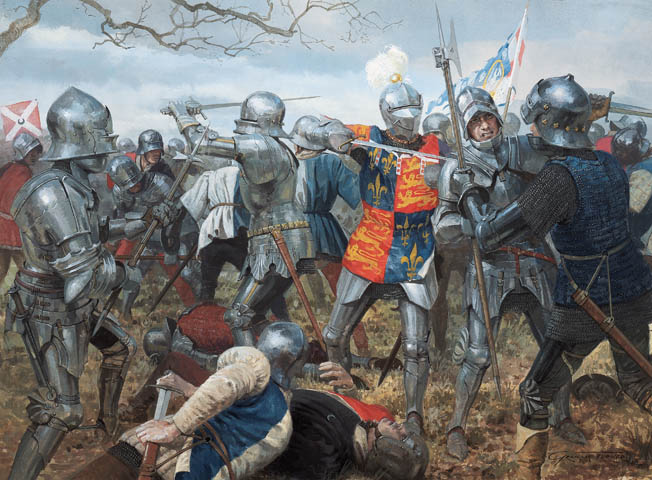
Within minutes of speaking his last words to his son, York and his men were attacked from behind by Clifford’s men advancing from Sandal Magna. An eyewitness described the outcome of the battle: “When [York] was in the plain ground between his castle and the town of Wakefield, he was environed on every side, like a fish in a net or a deer in a buckstall.” Assailed from all sides, York’s line crumbled. Those remaining alive fought in isolated pockets as the last of York’s force was crushed between the enemy like grain between millstones.
With no cohesive force left to lead, York threw himself into the melee. All around him men were dying. Disdaining to surrender, York took up his last position against a stand of three elm trees, where he fought gallantly until he was hacked to death. Once York was dead, all remaining resistance evaporated, and surviving Yorkists fled for their lives, discarding equipment and weapons that would slow their escape. Eager to settle scores that had festered over the past five years, the Lancastrians chased the defeated Yorkists and struck down a large number of them before they could get away. Other Lancastrian forces occupied Sandal Castle. The red rose had won the day.

Revenge of the House of Lancaster

The bodies of the dead were thrown into a large ditch next to the battlefield dug by the victors. That night a gentle snow fell on the battlefield where the dead were stacked together like cords of wood. The scene was recorded by a Yorkist soldier who survived the slaughter and was scouring the field for his slain father. “At midnight the kindly snow fell like a mantle on the dead and covered the battlefield with a blanket of white, which when it had finished gave no trace of what had gone before.”
Wakefield7
The Lancastrians thirst for revenge was not quenched with the death of York. Clifford caught up with Rutland and Aspall on Wakefield Bridge. Despite the youth’s pleas from bended knee, Clifford was merciless. “By God’s blood, thy father slew mine, and I will do thee and all thy kin,” he said, thrusting his sword completely through the boy’s throat until it came out the back of his neck. Salisbury was captured and led off to Pontefract, where he was beheaded the following day. The heads of the three Yorkist nobles were then taken to the city of York and stuck on spikes atop Micklegate Bar, the gateway into the city. In a further gesture of contempt, the Lancastrians placed a paper crown atop Richard’s head to mock his claim to the throne.
The Yorkist army at Wakefield lost 3,000 men. Lancastrian losses were far fewer. The knights who fell fighting for York include Bourchier, Hall, Harrington, Parr, Pickering, Retford, and Salisbury’s son, Thomas Neville. The Lancastrians were able to bask in their victory for only a short time. After the beginning of the year, Margaret joined Somerset’s army in Yorkshire, bringing with her both Scottish and French mercenaries. By extensive pillaging on its march south, the large Lancastrian army alienated the population of the Midlands. To keep them out of London, Warwick fanned the flames by spreading propaganda about alleged atrocities committed by the mercenaries and claiming that they planned to sack the city.

Monday, 19 June 2017

NATIVE AMERICAN MEDICINES


                                                   NATIVE AMERICAN MEDICINES


                                                          HERBS AND PLANTS


All plants are our brothers and sisters.

They talk to us and if we listen, we can hear them.

  -- Arapaho Proverb


AlfalfaAlfalfa - Known officially as Medicago Sativa, Alfalfa is a flowering plant in the pea family. Grown all over the world, it has been utilized in herbal medicine for centuries. High in protein, calcium, plus other minerals, vitamins in the B group, vitamin C, vitamin E, and vitamin K, it is best known to relieve digestive disturbances. Native Americans used it to promote blood clotting and treat jaundice. It is used for numerous medical issues today, including arthritis, muscle problems, to reduce blood sugar levels, eliminate toxins increase energy,bone strength, bladder and kidney problems, and easing menopause symptoms. Avoid alfalfa is you have an auto-immune problem, as it has been known to aggravate these types of disorders. 

American Ginseng - Officially known as Panax Quinquefolius, this herb is of the ivy family and native to the hardwood forests of eastern North America. Used by Native Americans long before Europeans arrived, it was used not only to heal a wide variety of ailments; but, also for spiritual and ceremonial purposes. Recognized as one of the five most valuable plant medicines by the Seneca, traditional uses included flu, colds, fever, sinus problems, to reduce swelling, and as a laxative. The herb was smoked like tobacco by the Iroquois, and used in sweat baths by the Seminole. It was also dried for use in teas and tonics by the Cherokee, Creek, Houma, Mimac, Mohegan, and Potawatomi for a variety of medicinal purposes. Some tribes used at as a body rub. Another not so common use was using the herb to attract a mate, such as the Meskwaki women to gain a husband, and Pawnee men who used Ginsing as a love charm. Europeans quickly saw its benefits in the early 1700's, so much so that French traders in Quebec, who had contracted with local Indians to purchase  the ginseng they could find, effectively eliminated out the native stands of the herb around Montreal.
Native Plants Native Healing BookAmerican Hemp - See Indian Hemp

Allspice - Formally known as Pimenta Dioica, this fragrant spice is not only used in cooking and seasoning, but also as an herbal remedy. Also known as Jamaica Pepper, Kurundu, Myrtle Pepper, Pimenta, Clove Pepper, and Newspice, it owes its healing powers to "eugenol," a chemical component in its oil that aids digestion and is an effective pain reliever. It's dried unripe berries have long been used in teas for treatment of colds, menstrual cramps, upset stomach, indigestion, flatulence, diabetes, toothaches, and relief of muscle aches and pains. The berries have also been crushed and made into poultices and salves and applied directly to bruises, sore joints, aching muscles.

American Licorice - Officially known as Glycyrrhiza Lepidota, and sometimes called wild licorice, it is native to most of North America, from central Canada south through the United States to California, Texas and Virginia, but absent from the southeastern states. Its roots have been widely used by a number of Native American tribes in teas for the treatment of cough,diarrhea, chest pain, fever, stomach aches, and to speed the delivery of the placenta after childbirth. It is also used as a wash or poultice on swelling . The chewed root is retained in the mouth as a treatment for toothache and sore throats. The mashed leaves are used as a poultice on sores.

allspiceAmerican Mistletoe - Specifically known as Phoradendron Leucarpum, this is a species of mistletoe which is native to the United States and Mexico. Its common names include Eastern Mistletoe, Hairy Mistletoe, Oak Mistletoe, Pacific Mistletoe, or Western Mistletoe. Druids in Europe used another species of mistletoe some 1,500 years ago for convulsions, delirium, hysteria, neuralgia, and heart conditions. Native Americans used Phoradendron in similar ways for blood pressure, lung problems, epilepsy, headache, abortions and as a contraceptive. The Cherokee made a tea ooze that was used to bathe the head for headache and the Creek made a concoction for lung troubles, such as tuberculosis. The Mendocino Indians often used the root to induce abortions and to prevent conception. Other uses included chewing on the root for toothaches, rubbing the body with a decoction of leave for painful limbs and joints. It was also used by some tribes in religious ceremonies. The plant is considered as poisoness and should be used with caution.

Antelope Sage - Formally known as Eriogonum Jamesii, this herb is a species of wild buckwheat also known as James' Buckwheat. Native to southwestern North America, in Colorado, Utah, Arizona, Texas, New Mexico, Oklahoma, and Nebraska; it was often used as a contraceptive by Native Americans, such as the Navajo. The women would drink one cup of a decoction of the root during menstruation. A decoction of the whole plant has also been used to ease the painof childbirth, and the root was chewed or used in teas as a cardiac medicine, for stomach aches, and depression. Some made a wash that was used for sore eyes.


Arnica - A member of the sunflower family, one species, called Arnica Montana, has been used for centuries by both Europeans and Native Americans as a topical cream or ointment to soothe muscle aches, reduce inflammation, treat sprains and bruises, and heal wounds. Arnica should not be taken internally as it has caused severe and even fatal poisoning.

Ashwagandha - Formally known as Withania Somnifera, it is also called Indian Ginseng, Winter Cherry, Ajagandha, Kanaje Hindi, Amukkara, and Samm, it is native to the country of India and has a long list of medicinal problems it is used for. Ashwagandha is one of the most widespread tranquillizers used in India, where it holds a position of importance similar to ginseng in China. It acts mainly on the reproductive and nervous systems, having a rejuvenate effect on the body, and is used to improve vitality and aid recovery after chronic illness. The whole plant, especially the leaves and the root bark, are used as an antibiotic, aphrodisiac, diuretic, narcotic, and sedative. It is used to treat post-partum difficulties, nervous exhaustion, insomnia, impotence, infertility, multiple sclerosis, chronic fatigue, dehydration, bone weakness, muscle weakness and tension, loose teeth, constipation, senility, memory loss, and rheumatism. Externally it has been applied as a poultice to boils, swelling and other painful areas. Caution is advised in the use of this plant since it is toxic.

Quaking AspenAspen - Aspen trees are native to cold regions with cool summers. In North America, this includes the far north portions and extending south at high altitudes in the mountains. There are several varieties of Aspen trees, one of which -- the Quaking Aspen, which was used by both Native Americans and early pioneers to treat fever, scurvy, cough, pain, and as an anti-inflammatory. The inner bark of this tree contains salicin, a substance similar to the active ingredient in aspirin.

Astragalus - A large genus of about 3,000 species of herbs and small shrubs, it is native to temperate regions of the Northern Hemisphere. Common names include milk-vetch (most species), locoweed (some species in the western U.S.), and goat's-thorn. Used in both traditional Chinese and Native American remedies, the dried roots was often in combination with other herbs, to strengthen the body against disease. Traditional medicinal uses included the treatment of colds, flu, infection, allergies, asthma, fatigue, anemia, wounds, heart and kidney disease, hepatitus, stomach ulcers, and digestive disorders. It is also thought to help protect the body from diseases such as cancer and diabetes and is also used to protect and support the immune system, for preventingcolds, upper respiratory infections, lower blood pressure, treat diabetes, and to protect the liver.


Atractylodes - Long used in Traditional Chinese Medicine, this herb is used for indigestion, stomachache, bloating, fluid retention, diarrhea, loss of appetite, weight loss, allergies, and rheumatism. It is used with other herbs for treating lung cancer, and kidney problems.


Cherokee Medicine

Like numerous other Native American tribes, the knowledge of Cherokee medicine was handed down from generation to generation to the "chosen" healers. Traditional Cherokee members consulted their medicine people for not only medical problems, but also dilemmas in their lives, and emotional problems. Like other Native American tribes, their most frequently used remedies were for common colds, aches and pains.

Some common herbs used by the Cherokee as well as other Native American tribes was boneset tea, as a remedy for colds, while wild cherry bark was used for coughs, sore throat, and diarrhea. To ease the pain during childbirth and speed the delivery process, Blue Cohosh root, was used in a tea. Using Wild Carrot Blossoms and Devil's Club could offset the ill effects of Diabetes. Fevers were soothed with teas made from Dogwood, Feverwort, and Willow bark. A still famously enjoyed Pennyroyal tea was thought to cure headaches, and they used Native Hemlock to help with the flu.

Some serious surgeries that required sedatives would usually be prepared with Wild Lettuce, Hops, and Wild Black Cherry. Heart and circulatory problems were addressed using Green Hellebore, American Hemp, and Dogbane. Many of these Native American remedies were the basis for the modern medicines that are commonly used today such as penicillin.

** Note: The information above is courtesy of the Cherokee Nation Cultural Resource Center who cautions that it must be remembered that these plants are very valuable as medicines because of the great chemical powers they contain. At the same time, these chemicals can be potentially dangerous if used in the wrong way. Cherokee herbalists have great experience, and have gone through extensive training and observation.


NATIVE AMERICAN LEGENDS

Medicine Bags or Bundles
Bookmark and Share


Native American Medicine Bags

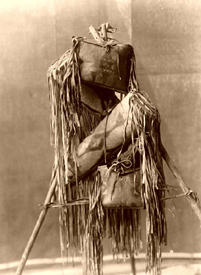
Native American Medicine bags, Edward S. Curtis, 1910.

This photo available for photo prints & commercial downloads HERE!


CURSE WORD ALTERNATIVES